Kinkaku-ji

Kinkaku-ji
The Golden Temple, Kyoto, Japan. One of the many amazing places I visited on my Japanese Exchange 2004. Click on the image for more information

Monday, October 13, 2008

Career Path

Although I am not entirely sure where I see myself after I have finished my degree, I have been looking into the different options I have. I am in my first year, so still have a while to decided which direction I will go.. But here are some ideas...

First, I was thinking, since I already have a CELTA (Certificate in English Language Teaching to Adults) I could stay in New Zealand and teach international students here, or I could go to Japan and teach English there.

There are many different programmes that I could go with for teaching English in Japan, and many different websites where I can find more information- www.gaijinpot.com, and www.workinjapan.com.

Jet

These programmes place you in schools, and local governments around Japan, and help you with accomodation. There is a very strict application process.


Another option is staying on at AUT and studying translation.

Here is a little information about the course I have been looking into, although I would have to wait until I finish my degree to get into the course, as that is the minimum requirement.

Certificate in Translation Studies

Introduction to Language Study (165105) and Theory, Principles and Practice of Translation (167007). The programme enables students to develop a greater understanding of the real nature of language and translation, comprehension of the many phases of the translator’s task and establishes appropriate methods of translation over the widest possible range of texts and categories.
1 Year Part time


Diploma in Interpreting and Translation

The Diploma in Interpreting and Translation has been designed to be taken part time over two years, but it can be taken as a full time programme of study in certain cases. This is a comprehensive course designed to prepare professional interpreters and translators to work in a variety of community settings in New Zealand or to carry out a range of translation assignments for clients both in New Zealand and overseas.
1 year full time / 2 years part time


_________________________

Or I was thinking, I could work in a Japanese Travel Agency, either in Japan or I could start my own business here.

I met a Chinese woman during my CELTA course who did a similar thing, but a Chinese travel agency. Her business was very successful, and she was able to do teaching on the side.

Anyway as I said, I don't know what I want to do yet, I am figuring it out along the way. Maybe one day something will just jump out at me, but for now I am happy just looking into my different options, and seeing what is available for me.


Information and Images Courtesy of:

  • www.aut.ac.nz
  • www.wikipedia.org
  • www.jetprogramme.org
  • www.traveltoucan.com/files/Japan-flag.gif

Monday, October 6, 2008

Things I love about Japanese Culture: Pt 3

Part Three:
Vending Machines

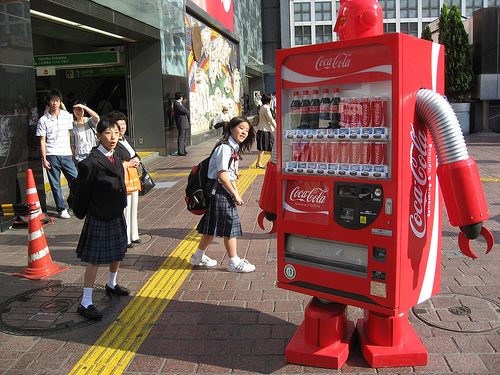
As I said earlier, Japanese people are so crazy and funny, and one of the little quirks about Japanese culture is their huge collection of vending machines. They're EVERYWHERE! and sell everything from Cameras to Fortunes, Underwear to Eggs.
According to the Japan Vending Machine Manufacturers Association, there is roughly one vending machine to every 23 people in Japan.


Above is a vending machine Omikuji, small fortune telling scripts.


Egg Vending Machine


Flower Vending Machine


Alcohol Vending Machine


And, if you don't have any change, you can now pay for something from a vending machine, simply by charging it to your cell phone.

There are even vending machines that walk.


Images Courtesy of:


Monday, September 29, 2008

Things I love about Japanese Culture Pt 2

Part 2:

Love of Religion

Religion is basically the founding of Japanese culture. The main religions in Japan are Shinto and Buddhism.
Most Japanese people don't neccessarily align themselves with only one religion, but instead incorporate the practices of each religion into their everyday lives.

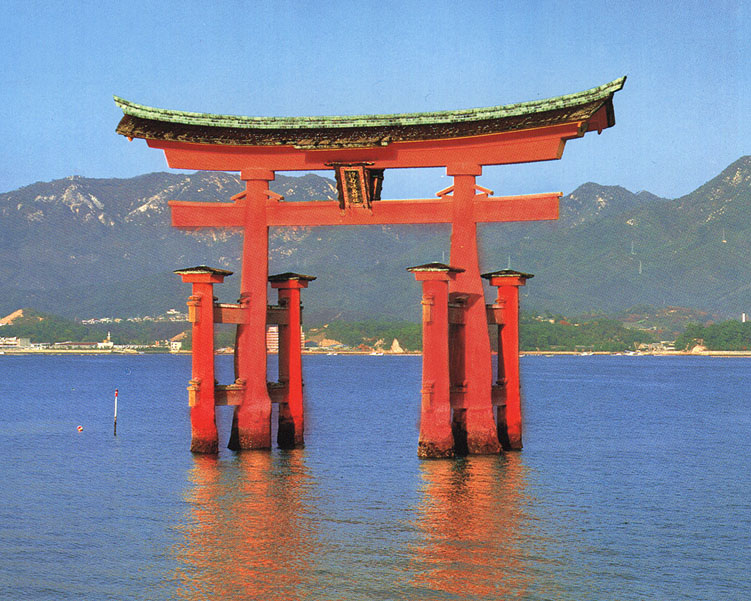
Shinto originated in Japan, and means "Way of the Gods". Shintoism is practised at a Shrine, and every Shrine has a red gate as you enter.


The Shinto gate shown here is very famous in Japan, because it is situated in the water coming in to Miyajima Island, Hiroshima. It is the gate to the Itsukushima Shrine.


Shinto Priests


Buddhism came from Baekje, Korea to Japan around 500AD, the Baekje king sent the Japanese emperor a picture of the Buddha, and the Japanese began to build many statues and temples in Nara and Kyoto.


Kiyomizudera, a famous Buddhist temple in Kyoto.


I love the way that religion in Japan is so prominent, and the way they have preserved old shrines and temples. It is very peaceful to be in that atmosphere, especially in Kyoto.

Ginkakuji '銀閣寺' (The Silver Pavillion), Kyoto. When I was in Japan I was lucky enough to visit this Buddhist temple, along with the one shown at the top of the page, Kinkakuji '金閣寺'.
Ginkakuji was built by Ashikaga Yoshimasa, who was trying to out do his grandfather who had the authority in building the Golden Temple, Kinkakuji.

I think its religion is something you can always learn from, and the way Japanese people practise both of these religions, almost without even realising it, on a daily basis amazes me. There is so much history in both Shinto and Buddhism, it may not necessarily be ALL Japanese history, but it is very interesting.


  • Images and Research Courtesy of:


Friday, September 26, 2008

My Tattoo

Last year, while I was holidaying in Samoa (from Australia) I decided to get myself more immersed in the Samoan life by doing something that is famously part of their culture... getting a tattoo. Of course, since I am not Samoan I didn't get a Samoan tattoo,(I think it is traditionally not acceptable for someone to get a Samoan tattoo who is not Samoan) but instead a map of New Zealand on my back.

Since then I had been thinking of another tattoo I wanted to get (its true: once you get one tattoo, you become addicted), and I really wanted it to be something that means a lot to me, so I chose a Japanese Kanji "あい"(AI) meaning "love".


When I was getting this tattoo, the guy at the tattoo shop (Ballistic Tattoo- Queen St)asked me why I was getting this particular tattoo.

I thought about it for a minute, and then replied 'Japanese is such a HUGE part of my life, and something I see myself continuing with for life, and I just wanted to have something that truely means a lot to me tattooed on my body'.

And thats the truth.
本当ね!

Things I love about Japanese culture Pt 1    日本語の文化が大好きなことは。。

Part 1:
Game shows


Japanese people are CRAZY! Their well known for their weird, yet hilariously entertaining game shows.
On my exchange to Japan, I noticed there is just game show after game show from about 3pm onwards..

For example a Japanese/American show that is currently showing on TV in New Zealand : I Survived a Japanese Game Show.


It basically consists of about 10 Americans going to Japan and taking part in a Japanese game show called 'Majide'(まじで)(meaning "seriously?!?" or "You've got to be crazy?"). The winner receives $250,000. It is a show within a show, and follows the American's lives in Japan also.


With its crazy host Rome Kanda(ろめ.かんだ), and the VERY excited audience, its not hard to see why this is such a popular part of Japanese culture.


Images courtesy of
http://www.abc.go.com/summer/isurvivedajapanesegame/index

Monday, September 22, 2008

My background in Japanese

これは、私の日本語を勉強しているについて書こう..

Here I will tell you a little bit about my background in Japanese, and where and how I became interested in the language.

Ever since I was about five years old my family have been hosting Japanese students in our homes, my parents had a friend that worked in a language school in the city (Auckland) so it will all organised through her- for those who are unfamiliar, this means that a Japanese student who is studying English in Japan comes on exchange to New Zealand, and stays in an English speaking house.
When they would come, they would stay for about 2 weeks, and during that time they would teach me bits and pieces of Japanese.
I was quite an outgoing child, and very eager to learn. They taught me simple things, like how to say, hello, goodbye, count to 10 and say 'I understand'.(わかります)
They taught me a bit about Japanese culture as well, showing me pictures of their family and friends in Japan, their hometown, and teaching me the Japanese art of Origami‘おりがみ’ (even giving me a book on Origami, which I still have to this day).


All of these little things sparked off my interest for Japanese. When I got to intermediate school, I had so many options of which language I wanted to study, but no Japanese. So I began to experiment with different languages- Spanish and Maori in my first year, and Korean in my second.
I found it very interesting to learn languages, and really enjoyed the experience of learning about another culture.. I even borrowed tapes and books from the library to try and teach myself French in my spare time.
When I finally got to high school, I discovered that they offered Japanese as a class I could take, so I chose it.

It was a trial at first, you would choose a class for 6 months and see if you liked it, and if you did you could continue with it the next year.
So I completed the six months and loved it. Especially learning how to write using a COMPLETELY alphabet and a characters.
For the next six months of that year I had to choose another class- I chose German.
Lets just say, it was a very hard six months. I didn't enjoy it at all, and that's no disrespect to German's or the language, but just to put it simply- I couldn't pronounce anything!

The next year I went back to Japanese and continued with it for the rest of my high school years (completing NCEA Level 3 in Japanese).

During that time I had the opportunity to go on exchange to Japan for 2 weeks, and stay with a Japanese family. This was organised through the Waitakere City Council.


It was an amazing trip! We (our group) flew into Osaka, and stayed with families in a small city called Kakogawa- which is about an hour and a half from Kyoto.
Each day we were doing different activities, going to Himeji, Kobe, Kyoto and Hiroshima. It was a trip I'll never forget, and this also developed my interest for travel, as this was the first time I had ever travelled anywhere WITHOUT my family.
I learnt so much about the history of Japan from that trip, going to different shrines and temples, visiting what's left from the bomb that was dropped on Hiroshima- it was such an eye opening experience.


When I came back, it was around August- and with my recent trip to Japan, and also being a member of Amnesty International, I made a speech to the Waitakere City Council about my trip, and then on Hiroshima Peace Day, made a speech to a full school assembly about what I experienced, and the significance of the day.

After that speech, the Mayor of Waitakere City - Bob Harvey, approached me and asked if I would like to join him on a trip he would be making to Japan the following year for the memorial day. Immediately I said YES, however the following year the trip was cancelled, due to other committments the Mayor had.

When I graduated from high school, I came top of my class in Japanese, and was awarded a scholarship. As this point I was very unsure about what I wanted to do in life ( I still am a little), and didn't want to think about going to university for another 3 years. So I used the scholarship to complete a one month intensive Certificate in English Language Teaching to Adults at Unitec.

Shortly after I decided I needed a change, and moved to Sydney, Australia.


Throughout my time in Sydney, I was working at a marketing company, called Harte-Hanks. I met a man by the name of Riki there, who was from Okinawa, Japan. I told him of my Japanese studies, and my interest in Japan, and he offered to help me with my Japanese while I was living in Australia. So every now and then he would give me a topic, and I would write him a short piece for him to mark, and he would return it to me the next day with his comments and corrections.
It was after doing this for a while that I decided I wanted to start seriously learning Japanese again, I enrolled in the Bachelor of Arts-Japanese course, and booked a one way ticket back to Auckland.


Learning Japanese now on a daily basis is perfect for me, and compared to 3 times a week classes in high school, I am learning new things and expanding my knowledge of the language a lot more rapidly.


Images courtesy of

http://www.jccc.on.ca/JCCC_Images/origami4.jpg

http://lh5.ggpht.com/_JCCInva_xvA/R39FIQAAY4I/AAAAAAAAAo4/7aCkbptLD0M/060+Flight+from+Auckland+to+Sydney.jpg

http://www.ilpsuccess.co.nz/images/aut_logo.jpg